
Specialists from the Faculty of Information Technologies and GosNIIAS Create an Effective Method for Diagnosing Pilot Performance Based on Quantum Representations
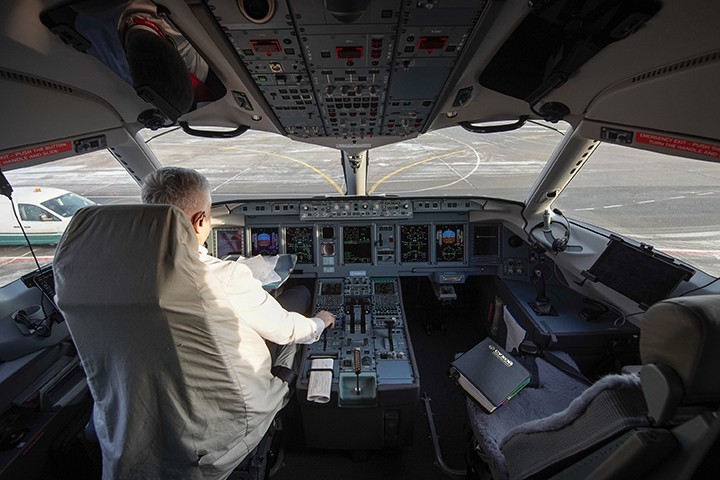
Specialists from the Faculty of Information Technologies of Moscow State University of Psychology and Education (MSUPE) and the State Research Institute of Aviation Systems (GosNIIAS) have developed a new approach to objective quantitative assessment of pilots' professional skills and psychophysiological state.
The work is driven by the need to improve flight safety: statistics show that for every hour of flight, there are only 5 minutes of manual control, yet it is during this period that up to 67% of aviation accidents occur. The high cost of error necessitates reliable diagnostic tools.
The study of crew activity, considering all its numerous components (from analyzing pilots' eye movement trajectories to assessing their impact on controls), represents a complex mathematical problem that cannot be effectively solved using classical mathematical apparatus. Russian specialists have developed a new method for determining the psychophysiological states and types of professional activity of pilots using quantum representations built on the convolution of Markov processes, represented by matrices of transition probabilities between the types of elementary operations performed by the crew and the aircraft's states. The obtained estimates indicate significant advantages of the new approach compared to classical methods of analysis. The main reason for these advantages is the ability to analyze observations in temporal dynamics, which is critical for correct diagnosis of pilot performance and is ignored in traditional approaches.
The apparatus of quantum representations for solving diagnostic problems has been developed by Russian authors since 2021. In terms of computational efficiency, it significantly surpasses the conceptually similar but practically cumbersome methods of quantum modeling and optimization developed around the same time by foreign scientists (specifically, specialists from the quantum science, physics, and mathematics departments of the University of Manchester in the UK).
The mathematical advantages of the Russian approach ensure the ability to work with small data volumes, ease of interpretation, and high diagnostic accuracy. This makes it applicable where classical methods require too much data or yield unstable results, and the complex quantum models used by foreign researchers are redundant. The Russian approach is much simpler to implement in software. In contrast, the Manchester approach requires special mathematical apparatus, "big data," and tensor libraries, making it accessible only to a narrow group of specialists and not allowing it to go beyond "toy" applications.
The results obtained suggest the prospects for implementing the approach developed at MSUPE and GosNIIAS not only in aviation but also in other areas where performance assessment of operators of complex technical systems is required.
Kuravsky, L.S., Greshnikov, I.I., Orischenko, V.A., Yuryeva, N.E., Yuryev, G.A., Makhortov, I.A., Ermakov, S.S., Sokolov, A.V., Zakharycheva, A.A. (2026). Diagnostics of Pilot States and Activity Types Based on Quantum Representations. Modeling and Data Analysis, 16(2), 42–66. https://doi.org/10.17759/mda.2026160202