
On Crisis Psychology Today: Theory, Practice, and Help in Overcoming Trauma – in the Journal "Extreme Psychology and Personal Safety"
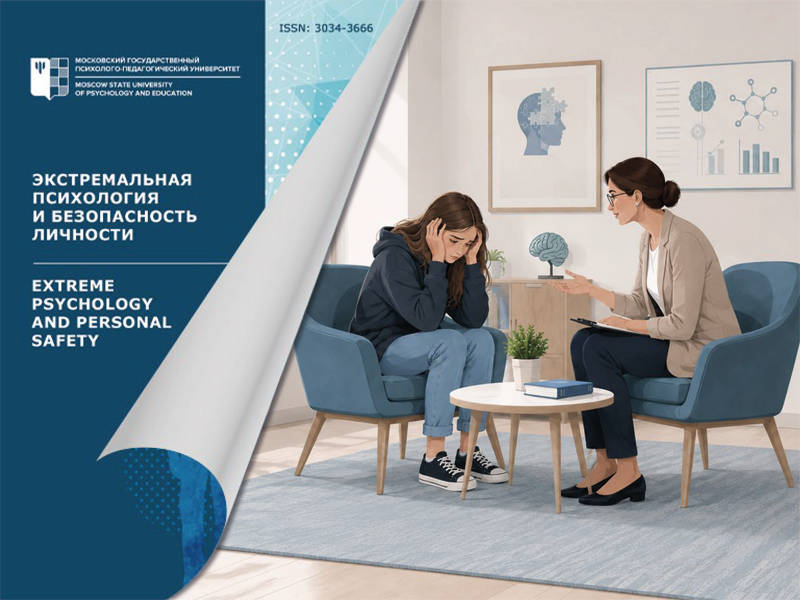
A new thematic issue of the journal "Extreme Psychology and Personal Safety" dedicated to crisis psychology (No. 2, 2026) has been published. The thematic editor of the issue is Leonid Abramovich Pergamenshchik, Doctor of Psychological Sciences, Professor at the Department of Social and Family Psychology, Faculty of Psychology, Belarusian State Pedagogical University named after Maxim Tank.
The field emerged in the late 1980s in response to the need for psychological assistance to victims of the Chernobyl disaster; in 1997, it received the official name "crisis psychology."
The materials of the issue are structured into three key sections – in each, readers will find current theoretical developments, results of empirical research, and applied solutions for working with crisis states.
In the "Theoretical Research" section, one can get acquainted with the fundamental foundations of crisis psychology and trace how different scientific traditions help to understand the experience of trauma. In particular, L.A. Pergamenshchik's article examines experience as a mechanism for overcoming a crisis event: the author conducts a comparative analysis of phenomenological, hermeneutic, and cultural-historical approaches and shows how their integration allows one to see a person's path from trauma to personal growth. The article by R.V. Kadyrov addresses current problems of crisis psychology, as it is devoted to the strategic approach in psychological assistance systems – crisis intervention, a method of short-term psychological assistance with its own special requirements for time, space, and therapy techniques. The author highlights the fundamental requirements for crisis intervention specialists that will allow them to conduct assistance procedures most effectively: accurate assessment of the crisis state, ability to think quickly, orientation toward short-term work, ability to apply simple but effective methods of assistance, and emphasis on restoring safety and control. The article will undoubtedly be useful both for researchers and practitioners in crisis psychology, social workers, and volunteers involved in helping victims of extreme events.
In the "Problems of Psychological Safety in Developmental Psychology" section, research is presented revealing how crisis situations affect different age and family groups and what internal resources help maintain psychological safety. The article by E.Yu. Kozhenevskaya is devoted to sibling relationships as a resource for psychological safety in families raising a child with special needs: the work presents statistical data on the growing number of such children and shows how neurotypical siblings can act as a stabilizing factor in the family system. In the material by E.A. Petrazhitskaya, the focus shifts to women who have experienced perinatal loss: the author proposes to consider the transformation of time perspective as a criterion for post-traumatic growth, which expands the understanding of the mechanisms of restoring psychological well-being. In this section, specialists can find evidence-based models of support and criteria for assessing the dynamics of clients' conditions across different age groups.
The "Psychological Assistance in Extreme Situations" section is practice-oriented and contains crisis intervention tools applicable in real work with victims. The article by L.A. Vertynska demonstrates the possibilities of narrative analysis: using a transcribed interview as an example, it reveals how the reconstruction of a life history helps to study traumatic experience and cope with the "speechlessness" often accompanying trauma. Readers will be able to familiarize themselves with methodologically constructed approaches to analyzing experience and use these ideas as a basis for their own research. The material by S.A. Yangibayev reveals the delicate problem of shame as a barrier to overcoming the consequences of sexualized violence and shows how a narrative interview can simultaneously serve as both a research and therapeutic tool. In this part of the issue, readers will be able to learn about specific assistance strategies, criteria for intervention effectiveness, and practical recommendations for psychologists, social workers, and volunteers working under extreme stress.
The issue concludes with the "Extreme Psychology" section, which, at first glance, deviates from the main theme of the issue. However, the new thematic issue "Crisis Psychology Today" organically combines the historical logic of the field's formation and the most acute contemporary challenges of psychological practice. The scale of social tension is constantly expanding, encompassing increasingly complex humanitarian and extreme contexts. The article by V.E. Petrov, "Personal Predictors of Information and Psychological Security of Extreme Volunteers," presented in the issue, is devoted to one of the most urgent tasks today – ensuring the information and psychological security of extreme volunteers. In conditions of high information pressure, it is the individual's resilience to negative influences that becomes a critically important resource. The article by V.M. Pozdnyakov, "The Wisdom of Life-Creation and the Prolongation of Professional Longevity in People of Retirement Age," is devoted to the problem of extending the professional activity of "silver age" people in the context of deteriorating demographics and a shortage of labor resources in Russia. The key focus is the "wisdom of life-creation" as a mechanism that helps maintain agency and prolong professional longevity. The article presents the author's Model of Professional Longevity and makes proposals in the field of countering age-related restrictions, including the prevention of "age ostracism." The author emphasizes an individually differentiated approach: to support retirees, it is important to track their value orientations, available resources, and the feelings of subjective well-being and psychological safety they experience.
The full issue of the journal is published in open access on the PsyJournals.ru Portal.