
On the poetics of the visual image in Russian literature in the "Language and Text" journal
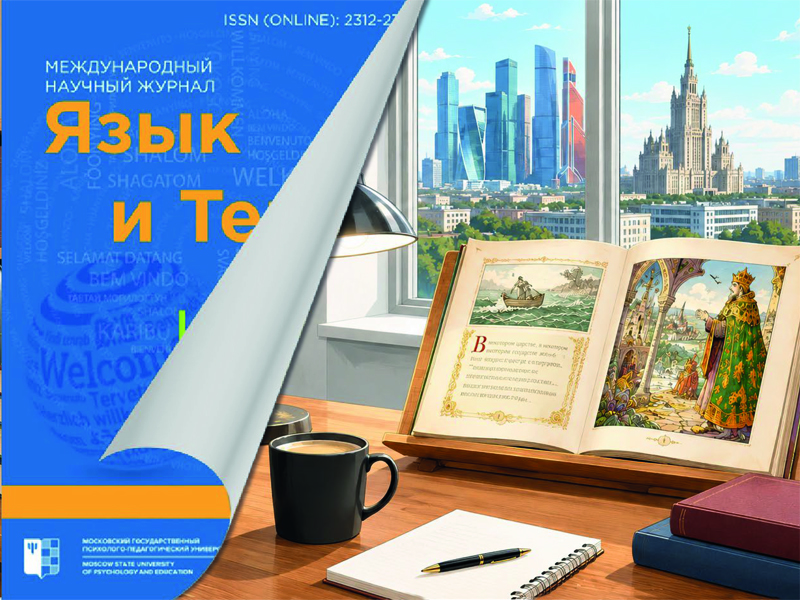
The latest issue of the International Electronic Scientific Journal "Language and Text" (No. 2-2026) has been released, dedicated to contemporary research in literary studies, linguistics, and language education. The guest editor for this issue is Ksenia A. Potashova, Doctor of Philology and Associate Professor at the Department of Russian and Foreign Literature, Faculty of Russian Philology, State University of Education.
The first section, "General and Comparative-Historical Linguistics," brings together research addressing current issues in linguistics, such as the organization of language as a system and its functioning across various cultural domains. The section covers a diverse range of topics. The authors analyze the principles underlying the construction of lexical-semantic fields and their lexicographic representation; the semiotic mechanisms of sign interpretation and translation within museum discourse; cognitive strategies of persuasion in political rhetoric; the discursive construction of regional media images; linguistic techniques used to create spatial and temporal continua in literary prose; a linguocultural analysis of socio-political concepts across different cultural traditions; and the pragmatics of phraseological units as persuasive tools in socio-ecological advertising texts. The unifying theme of this section is the understanding of language as a multifaceted phenomenon that reflects cognitive processes, societal values, and cultural dynamics.
The second section, "World Literature. Textology," is dedicated to the poetics of the visual image in Russian literature. The authors focus on the system of artistic techniques used to create visually perceptible images (portraits, landscapes, architectural spaces) in poetry and prose, examined in conjunction with the philosophical foundations and creative concepts of Russian writers. This section also covers a wide range of topics. The authors explore the development of descriptive prose in the early 19th century within the genre of the promenade, where the very act of contemplation provides both freedom for individual associations and the opportunity to convey historical and cultural allusions through visual imagery; the role of the library's architectural space as a cultural cosmos that unites the real and the imagined through ode-like admiration and elegiac reflection; the visual poetics of "mysterious" tales, where a character's gaze becomes a tool for penetrating the spiritual world, and the appearance and gestures of the heroes serve as a key to their inner drama; and the celestial landscape as a means of visualizing states of mind, where painterly and musical ekphrasis convey the connection between the earthly realm and eternity. The synthesis of word and image is further explored through book illustration, which the authors view as an independent form of expression capable of interpreting rather than merely accompanying a literary work. This aspect is comprehensively illustrated using engravings in 19th-century periodicals, where the visual series acts as a tuning fork for the textual material, as well as through modern editions of A.S. Pushkin's fairy tales. The unifying theme of this section is the understanding of the visual image as a fully-fledged meaning-generating element of a literary text.
The third section, "Linguodidactics and Innovations. Psychological Basis of Learning Languages and Cultures," brings together research addressing current issues in meaning transfer in cross-linguistic communication, and the impact of digital technologies on the processes of comprehending and producing academic and educational texts. The authors focus on translation, semiotics, terminology, and text editing within the context of the modern information environment. This section covers several key areas. The articles examine the specific functioning of author-coined terms in popular science discourse, analyze the processes of encoding and recoding English terminology, explore the phenomenon of semantic degradation in academic texts due to AI editing, and develop a methodology for the linguo-semiotic analysis of translation. The unifying theme of this section is the understanding of language and translation as active meaning-generating practices, where interpretation and cultural context play a decisive role.
The journal's materials will be useful to specialists interested in current issues in philology, as well as to anyone engaged with modern methods for analyzing active processes in language, new approaches to studying visual poetics, and intermedial analysis.
Listen to the latest episode of the PsyJournals LIVE podcast, where the author discusses her research:
Anna N. Semiletova — on the "semantic degradation" of academic texts under AI editing.
The full issue of the journal is published in open access on the PsyJournals.ru Portal of Psychological Publications.