
FCC MSUPE Experts Present a Report on the Balance of Humans, Algorithms, and AI at an All-Russian Seminar in Tula
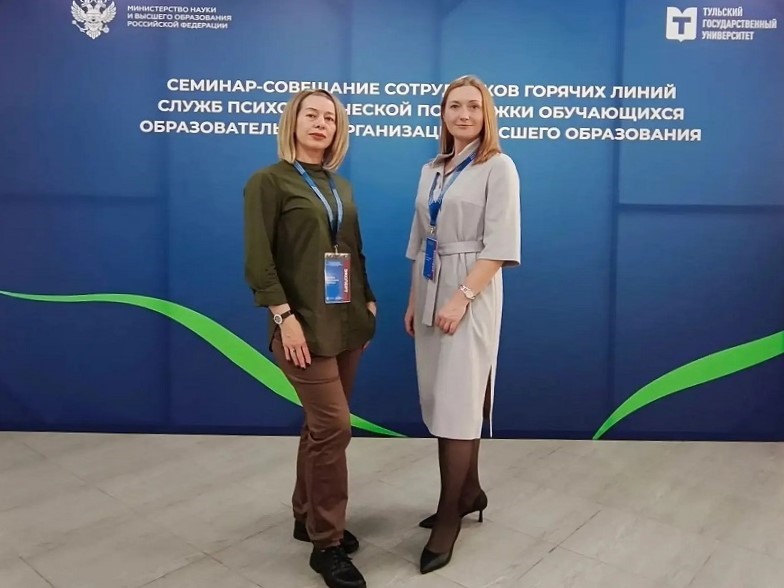
Specialists from the distance counselling sector "Child Helpline" of the Federal Coordination Center for Ensuring the Development of Psychological and Pedagogical Assistance in the Education System of the Russian Federation (FCC MSUPE) acted as experts at the All-Russian Seminar-Meeting of Hotline Staff of Psychological Support Services for Students.
The event was held in Tula from October 15 to 17. The organizers were the Russian Ministry of Science and Higher Education and Tula State University. The seminar brought together leading specialists from across the country to discuss current issues and exchange experience in the field of psychological assistance.
Yulia Alexandrovna Zhuravleva, Head of the Distance Counselling Sector, and Elizaveta Vyacheslavovna Vakhraneva, psychologist of the sector, presented a report on the topic "Human, Algorithm, and Artificial Intelligence: Professional Decision-Making in Telephone Counselling".
During the presentation, FCC MSUPE experts examined in detail how scripts, algorithms, and protocols relate to each other in the work of a hotline psychologist. Special attention was paid to the new challenges brought by the development of generative artificial intelligence. The specialists noted that the main risk of neural networks in helping professions is their "convincingness" : artificial intelligence is capable of instantly generating detailed but not always accurate answers, which can lead to automation bias and a decrease in the counselor's own professional competence.
The experts presented four models of AI application in emergency services — from the safe preparation of methodological materials to autonomous dialogue with a caller — emphasizing that the closer a decision concerns a specific person's safety, the less autonomy an automated system should have.
Using examples of real chatbot responses (including situations of suicidal crisis), the speakers demonstrated that artificial intelligence is not yet capable of replacing live human participation and clinical validation.
"A good algorithm tells a psychologist not so much what to say as what not to forget. And artificial intelligence does not reduce the amount of professional thinking — it creates an additional point for verifying it", noted Yu.A. Zhuravleva in her presentation.
In conclusion, the specialists formulated the main principle of work: in the system of relations "human – algorithm – artificial intelligence", the specialist always remains at the center. It is the counselor who must be able to perform the same work without a machine, preserving the skills of assessing the situation, justifying tactics, and taking responsibility for the final professional decision.