Psychological Trauma, Traumatic Stress, and Its Consequences: The Theme of the New Issue of Counseling Psychology and Psychotherapy
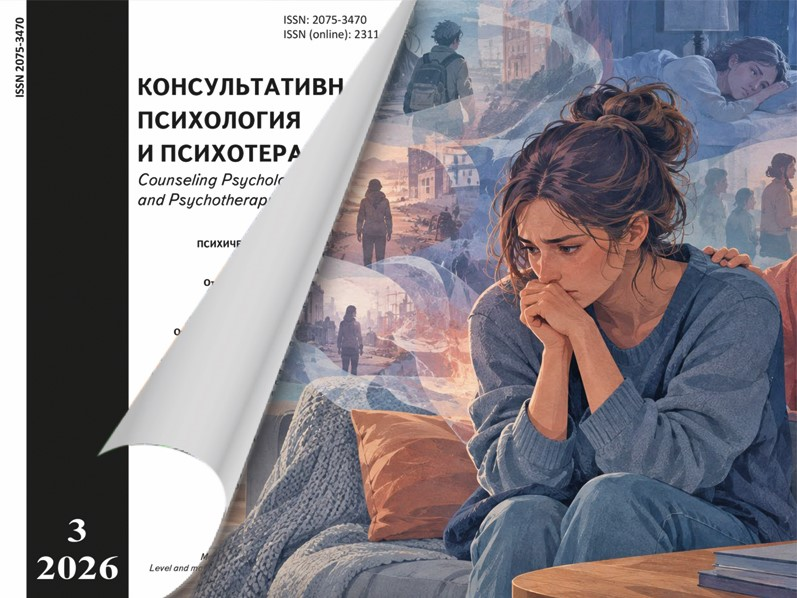
The thematic issue of the journal Counseling Psychology and Psychotherapy (No. 3/2026), dedicated to the problem of psychological trauma and its consequences, includes nine articles, including three theoretical reviews and four articles presenting the results of empirical research.
The "Theoretical Reviews" section opens with an analytical review by I.V. Kiselyova, dedicated to a comparative analysis of various approaches to the phenomenon of psychological traumatization. The article examines the limitations and resources of each approach. The authors of the second theoretical article, O.A. Sagalakova and D.V. Truevtsev, propose a continuum model describing how experienced trauma forms persistent expectations of threat that reconstruct reality along a spectrum from illusions to hallucinations. Notably, this model is based on developments in cultural-historical psychology, including the works of S.Ya. Rubinstein on the mechanisms of auditory hallucinations.
Finally, the last article in the theoretical section addresses a pressing issue in the age of digitalization—the possibilities of using artificial intelligence (AI) in trauma psychotherapy. The article presents a balanced summary of the debates between cyber-optimists and cyber-pessimists. The authors, L.I. Ivakhnenko and V.A. Maksimenko, demonstrate that while representatives of the cyber-optimist camp show a high level of enthusiasm regarding the potential of AI technologies in psychotherapy, they may overlook research pointing to high risks of AI in trauma therapy, as well as potential errors and negative consequences of using chatbots.
All remaining articles in the issue present original empirical studies of psychological traumatization in adults and children. Specifically, the first two articles (Yu.Yu. Pentsak; A.I. Khain et al.) examine the role of trauma in somatic pathology. An important strength of these studies is their longitudinal design conducted in a radiosurgery clinic and an oncology clinic. Although such a research design is labor-intensive, it significantly enhances the reliability and evidential value of the obtained data and conclusions.
The next article in the section is dedicated to investigating the specifics of experiencing bereavement in young adulthood. The authors, N.E. Kharlamenkova and A.A. Agisheva, attempt a fresh perspective on the problem of loss by differentiating between symptoms of traumatic stress and pathological grief.
The final three articles of the issue focus on stress-related problems associated with the context of the Special Military Operation (SMO) across various population groups. E.V. Tikhomirova, A.G. Samokhvalova, and M.V. Saporovskaya, authors of the first article in this block, emphasize that "the SMO context radically exacerbates the risks of stress against the backdrop of information overload, directly affecting the psychological and existential security of the individual." A group of authors—M.V. Baleva, N.A. Rudnov, V.A. Plotnikova, A.N. Shatskaya, E.G. Maksimenko, and I.V. Sultanova—presents a study on the impact of maternal stress and parenting style on the stress levels of preschool children. More than 3,500 mothers residing in various regions of Russia, including areas affected by armed conflict, were surveyed. Concluding the issue is an article by A.A. Pirogova et al., dedicated to assessing stress levels and the severity of PTSD symptoms in combatants admitted for treatment due to blast-induced barotrauma. The study design made it possible to identify the wounded individuals' subjective assessments of the primary sources of high psychological distress, as well as the resources that help them cope with it.
The journal issue is published in open access on the psychological publications portal PsyJournals.ru.