
Issue No. 3 of the Journal "Social Sciences and Childhood" Published
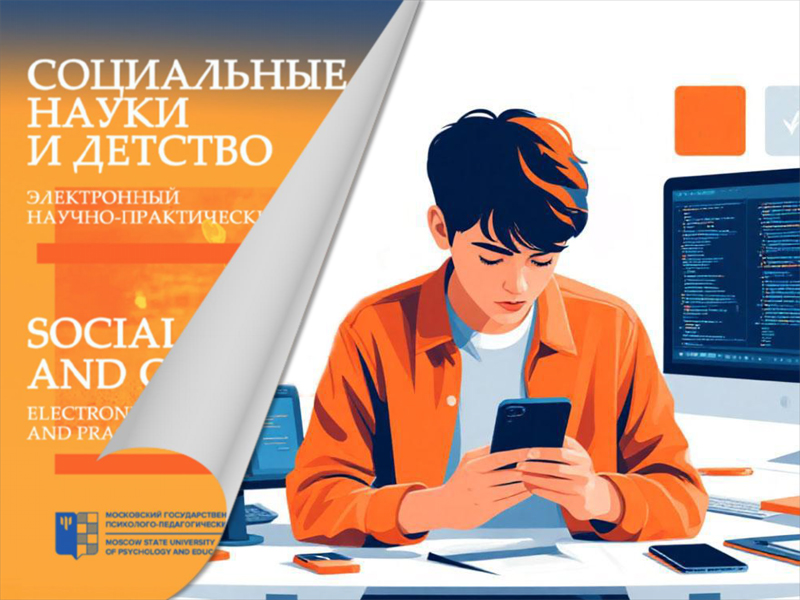
The third issue of the journal "Social Sciences and Childhood" for 2025 (No. 3, 2025) has been released. It brings together articles reflecting current socio-psychological issues faced by both professionals working in the field of childhood and children themselves.
The issue opens in the "General Psychology" section with a study by A.A. Zhdanova (Omsk, Russia), dedicated to examining the specifics of emotional intelligence among specialists in guardianship and trusteeship bodies with different job functions. It is shown that a high level of emotional intelligence helps reduce the risks of burnout and compassion fatigue, especially among employees working directly with children and families in difficult life situations.
The "Pedagogy and Educational Psychology" section presents the results of a comparative study by V.V. Kasperovich and E.M. Semyonova (Minsk, Belarus; Moscow, Russia) on the psychological well-being of professionally successful teachers versus teachers with difficulties in self-actualization. Differences were identified in characteristics such as resilience, life goals, sense of purpose in life, self-attitude, self-development, and self-control.
In the "Social Psychology" section, a joint work by V.N. Oslon, E.N. Stakhova, and U.V. Kolesnikova (Moscow, Russia) is dedicated to researching post-traumatic growth among candidates and foster parents. The authors associate a high level of post-traumatic growth in current foster parents with maladaptive coping strategies and a potential risk of burnout. For candidates, however, emotional intelligence serves as a key resource facilitating the beginning of the personal growth process.
An article by M.A. Odintsova and N.P. Radchikova (Moscow, Russia) is dedicated to analyzing life satisfaction and school engagement among Russian adolescents from different family types. The results show that adolescents from two-parent families demonstrate high levels of well-being and academic engagement, while adolescents from single-parent and blended families require additional psychological and pedagogical support.
The journal continues to publish analytical works considering the results of various epigenetic studies. From this perspective, the authors – E.I. Nikolaeva, E.A. Dydenkova, and G.V. Semya (St. Petersburg, Moscow, Russia) – examine the psychophysiological foundations of raising children left without parental care. Historical examples of the influence of external factors on the state of a child's genome methylation are cited, within the framework of assessing the condition of children born to mothers whose pregnancies occurred during the German blockade (the so-called "grandmother effect"), the "ice storm" in Quebec; everyday situations are also considered – the consequences of smoking and dietary changes in pregnant women. Analyzing the epigenetic mechanisms through which early traumatic experiences affect child development, the authors substantiate the necessity for specialized support for foster families at all stages, including adolescence.
The issue concludes with a review article by Yu.A. Kochetova and M.V. Klimakova (Moscow, Russia), dedicated to the formation of adolescent identity in the digital environment. The authors examine the mechanisms of social media's influence on the self-image, highlighting both risks—such as the gap between the real and ideal self, dysmorphophobia, context collapse—and opportunities: inclusive self-expression, the search for supportive communities, and the development of narrative identity.
This issue aims to broaden the horizons of understanding the complex interrelationships between the personal resources of adults, their behavior, and the well-being of children in a changing social and digital context.
We hope that the presented materials will prove useful for researchers, practicing professionals, and everyone who strives to create a safe and supportive environment for the development of children and adolescents.
The journal issue is published in open access on the portal of psychological publications PsyJournals.ru.