
A Prototype Service for Analyzing Scientific Trends in Psychology Presented at the Science Analytics 2026 Conference
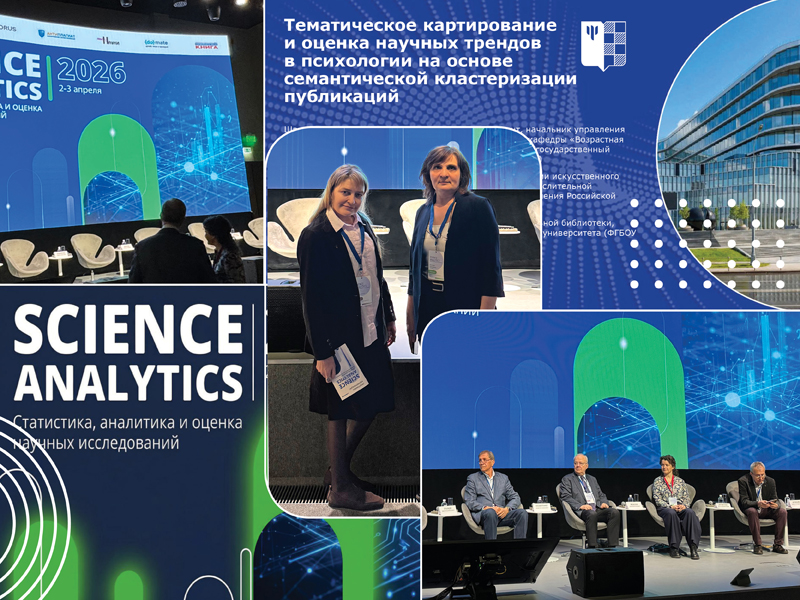
On April 2–3, 2026, the conference "Science Analytics 2026: Statistics, Analytics, and Evaluation of Scientific Research" was held in Moscow at the MSU Innovation and Technology Center "Sparrow Hills" (Lomonosov Cluster) , organized by the Scientific Electronic Library (eLIBRARY.RU) . The event was attended by representatives of scientific organizations, publishing structures, and the expert community in the fields of scientometrics and scientific analytics.
The conference program included a plenary session and six thematic sections covering issues related to the development of scientometric systems, open science, academic integrity, and the application of artificial intelligence in scientific analytics.
Among the discussed topics:
- Development of analytical tools on the eLIBRARY platform and expansion of indexed publication types.
- New criteria for assessing the quality of scientific journals and open access practices.
- Risks of using generative models, including the problem of "bibliographic confabulations."
- Application of semantic modeling methods and thematic decomposition of scientific activity.
As part of the section dedicated to the thematic analysis of scientific fields, a joint report was presented: "Thematic Mapping and Assessment of Scientific Trends in Psychology Based on Semantic Clustering of Publications." The authors were: A.A. Shvedovskaya, Candidate of Psychological Sciences, Associate Professor, Head of the Department of Information and Publishing Projects; D.V. Kosyakov, Researcher at the Laboratory of Artificial Intelligence and Information Technologies, ICM&MG SB RAS; and V.V. Ponomareva, Director of the Fundamental Library of MSUPE.
The presentation introduced a development from Moscow State University of Psychology and Education (MSUPE) – a prototype web service designed for the analysis and visualization of scientific trends in psychology. The service is oriented toward working with real publication streams. The empirical basis for building the service consisted of 929,119 scientific publications in psychology indexed for the period 2015–2024. The BERTopic method was used to construct the thematic structure of the field. The web interface features 531 scientific thematic areas.
Special attention in the report was given to:
- The introduction of integral metrics for assessing scientific topics (Impact and Impulse), reflecting citation rates and development dynamics.
- The creation of a user web interface for navigating scientific topics and analyzing their temporal dynamics.
The presented solutions in thematic mapping and scientific trend analysis are considered a promising tool for improving the quality of scientific research and supporting managerial decisions in the scientific field.
The results of the development are planned for use in future projects related to the development of the university's digital scientific infrastructure and are already available in the MSUPE Unified Digital Space service for faculty and students.