
Educational and Informational Webinar on the Organization of Collaborative Learning in Primary and Secondary School – August 27
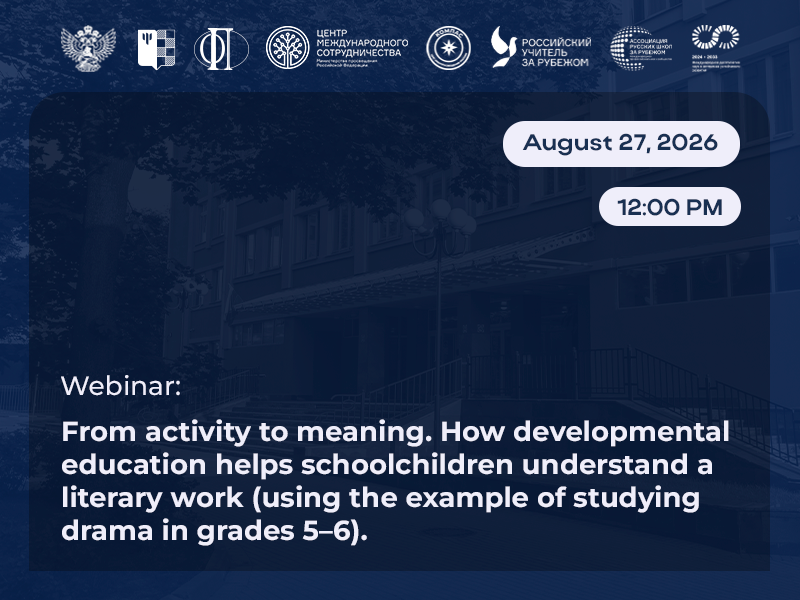
Every modern language and literature teacher has encountered the problem that students prefer a brief summary to a full reading of a work, delegate creative assignments to artificial intelligence, and during the reading of a literary text confuse the author with the narrator, the narrator with the characters, and the characters with each other... Why does this happen and what can be done about it?
On August 27 at 12:00 PM (Moscow time), Moscow State University of Psychology and Education (MSUPE), with the support and participation of the Center for International Cooperation of the Ministry of Education of the Russian Federation and the All-Russian Public Organization "Federation of Educational Psychologists of Russia," is holding an educational and informational event – a seminar-webinar on the dissemination of practices for organizing collaborative learning in primary and secondary school.
Webinar topic: "From Activity to Meaning: How Developmental Education Helps Schoolchildren Understand a Literary Work (Using the Example of Studying Drama in Grades 5–6)."
Speaker: Anna Alekseevna Zaretskaya, Postgraduate Student at the UNESCO Chair "Cultural-Historical Psychology of Childhood," MSUPE; Tutor – Teacher of Russian Language and Literature (Moscow School No. 109, Center for General and Supplementary Education "Hospital School 'UchimZnaem'").
During the webinar, we will explore the key principles of developmental education in literature – an approach through which a child not only successfully memorizes facts about a work but becomes a creator: an author, director, critic, and finally, a reader capable of understanding the author's position and formulating their own point of view on what they have read.
Participants will become familiar with the results of diagnostics of the reading development of schoolchildren aged 11–12; learn about the difficulties children face when interpreting literary texts of different genres; and master the technology of organizing learning activities in grades 5–6 that will make creativity in the classroom not just entertainment but a tool for analyzing and understanding the text, allowing children to develop their interpretive abilities and gain a deeper understanding of the author's intent.
The webinar will be of interest to primary school teachers, humanities teachers, and school psychologists.