MSUPE in the Media: "Rossiyskaya Gazeta", OTR, "Gazeta.ru"
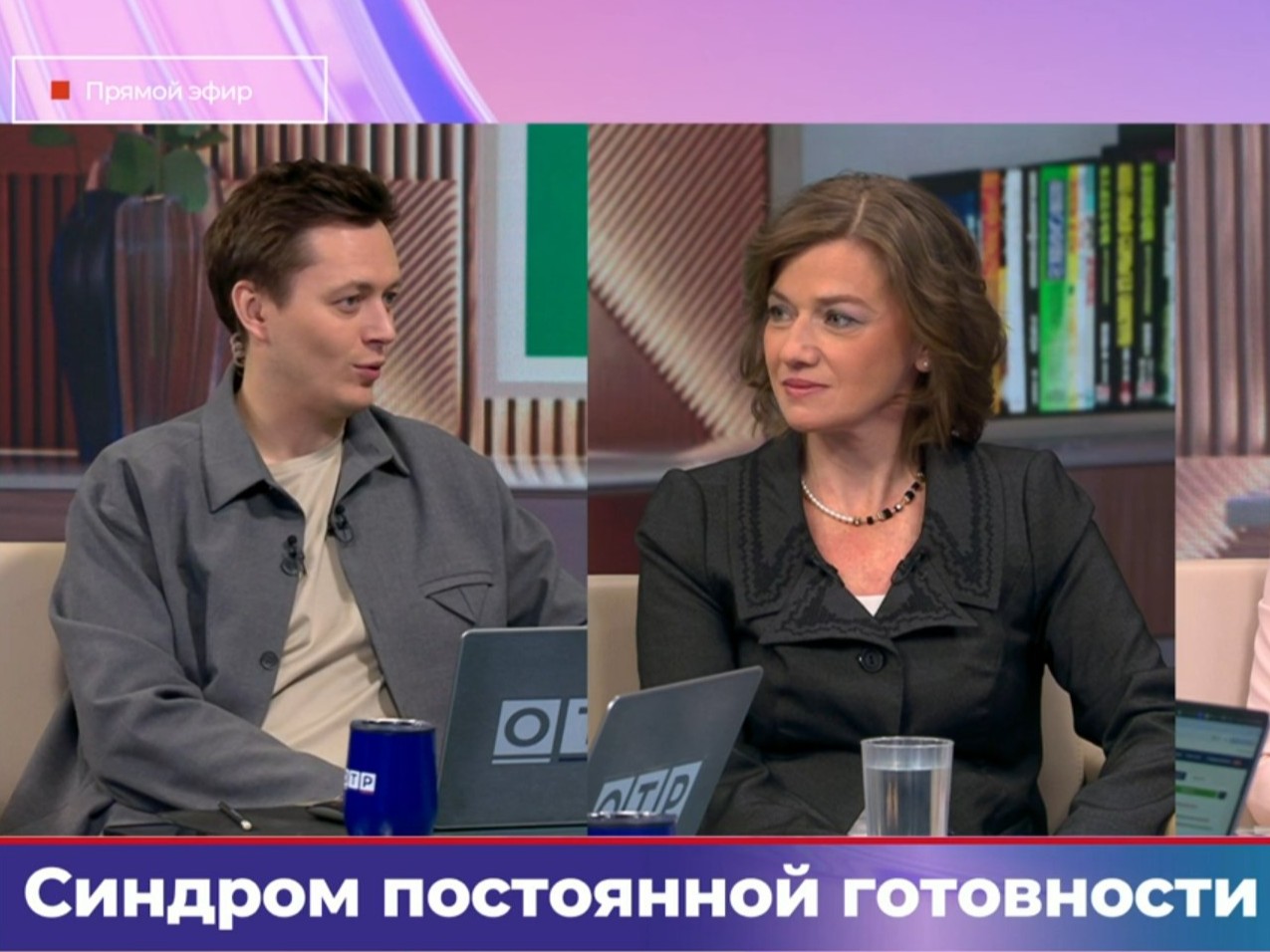
"OTRazhenie", OTR: Constant readiness or involvement syndrome is a feeling as if one cannot disconnect from the computer or phone: as soon as the gadget is put aside, the level of anxiety rises sharply. The brain has no opportunity to rest and continuously tries to solve important tasks. Together with our expert — Yana Onkamo, psychologist of the emergency response and psychological counselling sector of the emergency psychological assistance department of the FCC for Ensuring the Development of Psychological and Pedagogical Assistance in the Education System of the Russian Federation at MSUPE — we will figure out what makes this state dangerous, why it is important to sometimes stop and listen to oneself, and what consequences life in a state of constant haste, when the phone practically never leaves one's hands, can lead to.
Rossiyskaya Gazeta: In preschool education, upbringing and learning are not parallel actions but inseparable sides of a holistic educational process. This opinion was shared by Yulia Kochetova, Professor at the Faculty of Educational Psychology, MSUPE. The new standard of preschool education is based on the ideas of Russian psychologists Vygotsky and Elkonin, which explain the interaction of learning and development, as well as the role of play in these processes.
Central Trade Union Newspaper "Solidarity": What are the dangers and strengths of closed groups, to what extent should "borders" be opened, how to work with "castes" so that they do not hinder the common cause. Olga Krushelnitskaya, Professor at the Faculty of Social Psychology, MSUPE, explains.
MEL: A teacher plans to conduct a business game "Court" in class to analyze students' misdeeds — without the participation of parents and a school psychologist. Are his actions lawful? According to Nigar Aligaeva, Candidate of Psychological Sciences, Senior Lecturer at the Faculty of Legal Psychology, MSUPE, such a format is pedagogically dangerous and violates the law. The specialist emphasizes that the teacher has no right to organize such proceedings and suggests an alternative way to resolve the conflict.
Gazeta.ru: Researcher at the FRC ASD MSUPE Ulyana Mamokhina noted that there is no reliable evidence of a connection between screen time and the development of autism in children. The revealed statistical connection turned out to be insignificant, and possible explanations for the effect vary — from reverse causality to the influence of an unknown third factor. The expert also reminded that, despite the absence of a cause-and-effect relationship, screen time should be limited and complemented by games, communication, and walks.
Central Trade Union Newspaper "Solidarity": They keep to themselves and do not accept anyone, prefer to deal with "their own", and ignore outsiders. From a school class to company management, from a scientific institute to foreign "shadow governments" — the general principles of building a closed group are the same. Let's figure out how "castes" are formed. Olga Krushelnitskaya, Professor at the Faculty of Social Psychology, MSUPE, helps us understand.
MEL: It is not easy for teachers to find an approach when a child exhibits difficult behaviour, and parents are not ready to discuss his or her characteristics. Primary school teacher at the FRC ASD MSUPE Elena Krys comments: it is important not to make a diagnosis independently, but to record specific behavioural manifestations — for example, shouting out in class or conflicts with classmates. With these observations, one should approach the parents: discuss not the presumed diagnosis, but the child's difficulties and what help he or she needs now. Even without an official conclusion, the teacher should work with specific behaviour, not with an assumption of a diagnosis.
Central Trade Union Newspaper "Solidarity": To form a cohesive team, one needs to know by what rules it is built and how to motivate its participants for a common cause. However, people have different characters and levels of knowledge. And if each of them is in the right place and plays the part that suits them, the common cause will only benefit. Let's figure out the distribution of team roles together with Olga Krushelnitskaya, Professor at the Faculty of Social Psychology, MSUPE.
MEL: Oksana Gurina, Associate Professor at the Faculty of Legal Psychology, MSUPE, warns: encouraging snitching in class destroys trust between children and increases the risk of bullying. The expert explains that educators sometimes resort to such tactics due to lack of time, but in the long term, it causes serious harm to the psychological climate in the group. The psychologist emphasizes the importance of distinguishing "snitching for gain" from signals of danger — and gives recommendations to parents on how to discuss this topic with their child and correctly raise the issue with the school. Anna Adaskina, Professor at the Faculty of Educational Psychology, MSUPE, cautions against a blanket ban on reaching out to the teacher: this way, a child may decide that asking for help is shameful and remain silent in a situation of real threat. According to the expert, the task of parents is not to forbid complaining, but to teach the child to distinguish when adult protection is really needed and when they are simply being used.
Russian Education: The first open online parent meeting of the 2026/27 academic year was dedicated to protecting children from fraudsters in the digital space. Olga Yurchuk, Deputy Head of the Federal Coordination Center for Ensuring the Development of Psychological and Pedagogical Assistance in the Education System of the Russian Federation at MSUPE, advises parents to discuss lesson topics with their child on the same day — just like other school subjects. It is better to build the conversation through a request to "teach" the adult or through a hypothetical situation involving a third person, rather than by asking direct questions about the child's personal experience — this way the dialogue will be more natural and trusting.
MEL: Anna Semiletova, Candidate of Pedagogical Sciences and Associate Professor at the Faculty of Educational Psychology, MSUPE, explains: the school does not have the right to force parents to buy specific items, and a teacher cannot ignore a child's work because of the colour of a notebook. The expert emphasizes that requirements for cover colours have no legal basis — there are no such norms in the Law "On Education in the Russian Federation", and local school regulations should not restrict students' rights. According to the expert, under pressure from the teacher, parents should file a written application to the principal, and if the administration is inactive — contact higher authorities and protect the child from psychological pressure.
Institute for the Study of Childhood, Family, and Upbringing: Ahead of the new lesson "Important Conversations" dedicated to cybersecurity, a methodological seminar "Child Safety on the Internet: How to Talk About Risks Without Intimidation" was held for teachers from schools and secondary vocational education institutions. Experts prepared teachers for a conversation with children about current threats in the digital environment, focusing on preventing involvement in criminal schemes. Anna Ermolaeva, Deputy Head of the FCC for Ensuring the Development of Psychological and Pedagogical Assistance in the Education System of the Russian Federation at MSUPE, noted the importance of support and sincere interest in the child's life.
Uchitelskaya Rossiya: The Russian Ministry of Education summarized the interim results of the "School of Trust" psychological assistance line, which operates on the basis of the FCC for Ensuring the Development of Psychological and Pedagogical Assistance in the Education System of the Russian Federation at MSUPE. From September 11 to October 6, specialists at the "School of Trust" psychological assistance line received 1,613 inquiries — an average of about 60 calls per day. Most often, people contacted the line regarding conflict situations and intrapersonal problems, as well as academic difficulties.