
Proceedings of the International Conference "Zeigarnik Readings – 2025" Published in the Journal "Counseling Psychology and Psychotherapy"
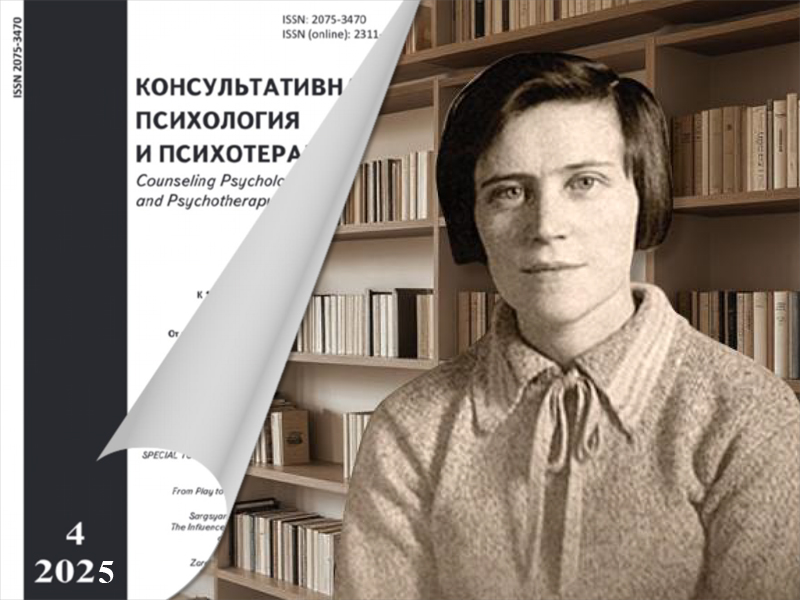
The fourth issue of the journal "Counseling Psychology and Psychotherapy" (2025-4), dedicated to the II International Conference "Zeigarnik Readings. Clinical Psychology in the Modern World: Challenges and Resources," has been published. This issue includes a brief report on the event (see the Editor-in-Chief's Preface) and articles based on presentations from various sections and round tables.
The issue opens with the section "Theory and Methodology." The article by D.G. Dyakov addresses a crucial methodological problem in modern psychotherapy – the integration of knowledge from different schools and approaches. The author formulates a set of methodological principles conducive to scientifically grounded integration when solving practical problems, countering the existing risk of eclectically mixing various techniques and methods.
The "Theoretical Reviews" section features two articles. The first, by a group of authors – O.V. Glukhova, V.Zh. Sarkisyan, M.M. Ispiryan, Yu.V. Zaretsky, and V.K. Zaretsky – reflects the experience of cooperation between Russian and Armenian specialists in the field of chess education in schools. The article provides an important theoretical justification for the hidden resources of this game, which include powerful mechanisms for developing a child's intellectual and emotional spheres. The second article deals with current issues surrounding the traditional format of psychoeducational programs in treating patients suffering from schizophrenia. The authors – A.V. Palin and N.A. Sirota – emphasize the necessity of conducting such programs during the early stages of inpatient treatment.
The "Method Testing and Validation" section includes one article dedicated to validating the Secondary Traumatic Stress Scale (STSS) for assessing secondary traumatic stress levels among professionals working with children and parents of children with disabilities and special needs. The authors of the article – E.A. Kazennaya, A.A. Zolotareva, A.S. Ulyanova, N.A. Lebedeva, and D.A. Karpova – demonstrated the high psychometric properties of the STSS methodology, which is now available to Russian specialists and can contribute to burnout prevention among representatives of one of the most important helping professions.
The final section of the special issue – "Empirical Research" – includes four articles. The first, by Belarusian researchers S.L. Boyko and K.V. Karpinsky, focuses on attitudinal regulation of vaccination behavior among healthcare workers and students in the context of the COVID-19 pandemic. The article by Yu.V. Batluk, E.L. Krasko, D.A. Laskoy, V.A. Rozanov, and A.V. Shaboltas examines risk factors for suicidal behavior among young people. Results from the study of familial factors in obesity are presented in the article by E.D. Flitman and co-authors. Finally, the last article in the issue reveals new aspects of the problem of education and methodological culture among modern mental health professionals. The author of the article, D.Yu Kolomytsev, substantiates the relevance of the problem of neuroreductionism in modern mental health sciences.
Interested readers can access recordings of the authors' presentations, as well as other conference materials, on the conference website and in the Telegram channel.