
At the XXV International Conference of Young Researchers at MSUPE, Current Issues of Training Scientific and Scientific-Pedagogical Personnel Were Discussed
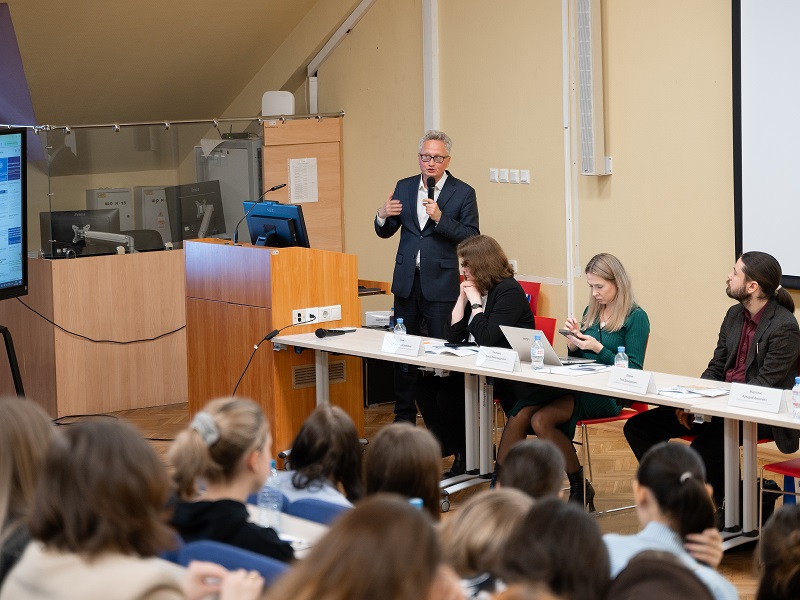
On April 28, as part of the XXV International Scientific-Practical Conference of Young Researchers "Evidence-Based Psychological Science for Practice Development: Research and Innovations of Young Scientists," a round table was held at MSUPE dedicated to the current challenges and strategies for training scientific and scientific-pedagogical personnel in doctoral (postgraduate) studies in psychological and psychological-pedagogical specialties.
Participants in the discussion included representatives and heads of dissertation councils, vice-rectors, and academic secretaries from leading universities (MSUPE, Moscow State Pedagogical University (MPGU), Moscow City Pedagogical University (MGPU), Herzen State Pedagogical University of Russia (RGPU), HSE University, and the Institute of Psychology of the Russian Academy of Sciences).
The round table was moderated by Sergey Gennadievich Kosaretsky, Vice-Rector for Scientific Work at MSUPE.
The experts' focus was on the problem of creating conditions for building an effective trajectory for young researchers in the field of psychological sciences. Participants discussed how to help doctoral students successfully master a set of key research competencies, conduct thorough research, and successfully defend their dissertations within the established timeframe during their studies.
Barriers to timely and successful defense were identified, related both to the level of preparation and competencies of doctoral students and to the existing institutional conditions at universities (the organization of doctoral studies and dissertation councils). At the same time, participants presented effective cases from universities and institutes for supporting young scientists "from admission to defense" and proposed a number of practical recommendations for universities aimed at improving the quality of doctoral admissions, the effectiveness of doctoral programs, and optimizing the process of preparing for defense.
In summarizing the round table, S.G. Kosaretsky concluded:
"The discussion revealed common problems and the community's interest in creating an inter-university platform, and possibly a network, for presenting and discussing experiences in solving them – both at the trial stage and for implemented models. Discussions, mutual consultations, and formulated proposals for improving the regulatory framework governing doctoral studies and dissertation councils are very important to all of us".