
MSUPE Publishes Analytical Report on the Professional Longevity of Educators
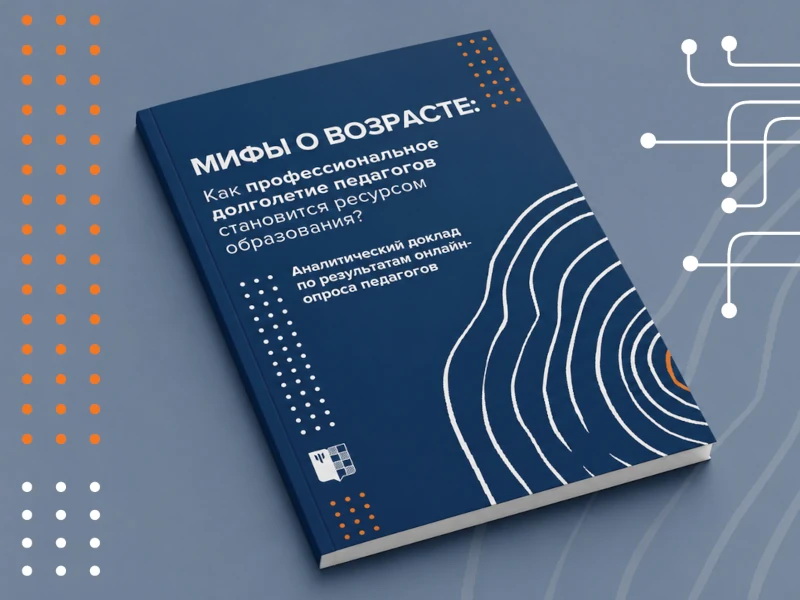
Moscow State University of Psychology and Education (MSUPE) has prepared an analytical report: "Myths About Age: How Professional Longevity of Educators Becomes a Resource for Education?" The publication is based on the results of a large-scale online survey of 9,799 educators from 75 regions of Russia.
The survey was conducted from October 20, 2025, to February 20, 2026, among workers in preschool, general, secondary vocational, higher, and additional education, as well as educators in private practice. Data was collected using the original questionnaire "Professional Needs of Educators: Resources and Risks," which assessed teachers' attitudes to work, their involvement in the professional community, emotional and cognitive well-being, health status, difficulties in professional activity, career goals, plans to continue working, and support needs.
The results were analysed considering the participants' age and field of employment. This made it possible to show how teachers' professional goals change at different career stages, what helps maintain interest in work, and what conditions are necessary for continuing professional activity in schools, kindergartens, colleges, universities, and additional education institutions.
The data obtained indicate that older age in the teaching profession is associated not so much with withdrawal from work as with a change in the nature of professional activity. Gradually, expertise, mentoring, the transmission of accumulated experience, and more flexible employment formats come to the forefront. The majority of older educators surveyed do not plan to leave the profession in the near future, maintain interest in their work, and remain involved in the professional community.
The study also showed that professional goals do not disappear with age but shift in focus. Older teachers' high professional confidence is combined with a need for digital support, while emotional load does not increase linearly with age, and subjective cognitive well-being remains stable. Participants increasingly associate the ability to continue working with more flexible workload regulation.
The authors of the report emphasise that responsibility for professional longevity cannot be placed solely on the educator. In teachers' view, continuing work in the later stages of a career requires systemic measures: reducing administrative burdens, health support, digital support, flexible employment formats, and creating conditions for mentoring activities.
The report was prepared by A.A. Shvedovskaya and V.V. Fedorov. The questionnaire "Professional Needs of Educators: Resources and Risks" was developed with the participation of A.A. Shvedovskaya, I.F. Roshchina, A.M. Rytikova, V.D. Tretyakova, A.A. Pavlova, and M.V. Kalantarova.
The full version of the analytical report is available on the PsyJournals.ru portal.
Citation:
- Myths About Age: How Professional Longevity of Educators Becomes a Resource for Education? : Analytical Report Based on the Results of an Online Survey of Educators / MSUPE ; A.A. Shvedovskaya, V.V. Fedorov. – Moscow : MSUPE, 2026. – 68 p. – ISBN 978-5-94051-386-5.