
On Intercultural Interaction and Ethnocultural Diversity in the New Issue of “Social Psychology and Society”
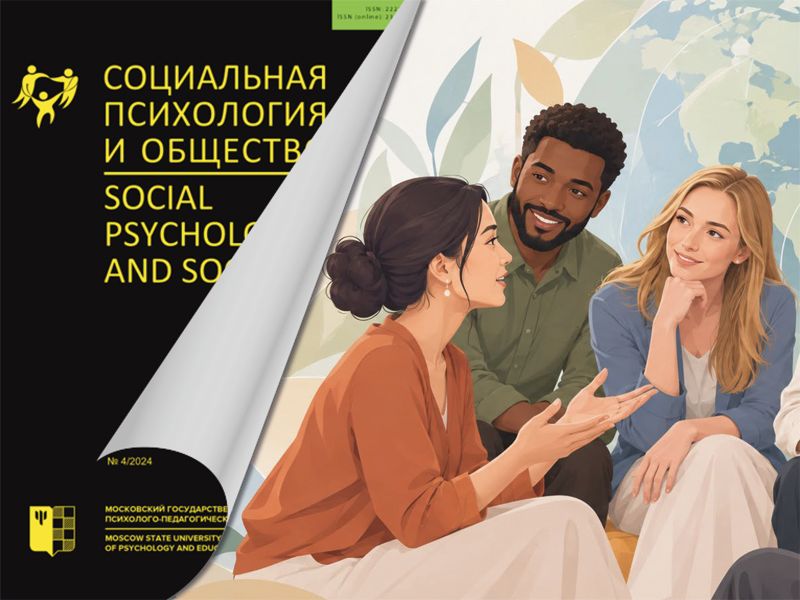
A new issue of “Social Psychology and Society” (No. 3, 2026), entitled “Ethnopsychology. Intercultural Communication”, has been published.
The issue opens with a foreword by the subject editor, Doctor of Science (Psychology), Professor V.V. Gritsenko, who outlines the main areas of research in ethnic and cross-cultural psychology and introduces the articles in the issue in relation to these areas.
One of the most actively studied issues in Russian and international research in recent decades has been the adaptation of individuals and social groups to a new ethnic and sociocultural environment in the context of migration. This topic is addressed in the articles by V.N. Galyapina, N.M. Lebedeva, and E.V. Bushina, “Psychological and sociocultural adaptation of forced migrants in the Krasnodar region: problems and resources for overcoming them”; A.M. Bukinich, L.A. Shaigerova, A.G. Dolgikh, and I.V. Sultanova, “The role of perceived social support in the psychological well-being of forced migrants”; Armenian researchers S.M. Asatryan, A.A. Ashikyan, and A.P. Ghazaryan, “Ecosystemic diagnosis of social integration among forcibly displaced children from Artsakh”; and I.A. Novikova, P.A. Bychkova, and A.L. Novikov, “Attitudes towards digital educational technologies among international and Russian students at multinational university: motivational and personality predictors”.
A central issue in ethnic psychology is ethnic identity. The results of one study in this area are presented in the article by Chita-based authors S.B. Dagbaeva, N.M. Saraeva, A.A. Sukhanov, and K.N. Pavlova, “The specificity of the relationship between resilience and civic and ethnic identity and strong-willed qualities among Buryat, Yakut and Russian youth”.
An important topic of intercultural relations in the post-Soviet space is addressed in the article by N.V. Murashcenkova, M.N. Efremenkova, and V.V. Gritsenko, “Belarus through the eyes of young Russians in the context of rapprochement between the two countries”.
The issue of intercultural competence (ICC) is explored in the article by M.A. Vyshelesskaya and M.A. Bultseva, “The relationship between intercultural competence and prosocial and antisocial creativity in Russian students”.
The issue also includes two methodological studies. The article by V.N. Burkova and M.L. Butovskaya, “Adaptation of the Russian-language version of the Dual Filial-Piety Scale (DFPS-RU)”, focuses on the adaptation of a tool developed by Asian researchers to assess respect for senior members of a group and characteristics of intergenerational communication. The article by M.Yu. Chibisova, N.V. Tkachenko, and O.S. Pavlova, “Assessing the social skills of migrant students: a theoretical model and the development of a diagnostic tool”, presents a method designed to assess the level of social skills development among migrant students.
The issue also features articles beyond its main theme.
The “Theoretical Research” section includes an article by D.V. Melnikova, N.V. Dvoryanchikov, E.D. Belova, and I.B. Bovina, “Social identity as a determinant of coping behavior in convicts: a theoretical model”.
In the “Discussions and Disputations” section, N.M. Sarayeva, S.B. Dagbayeva, and A.A. Sukhanov, in their article “Two terms for one concept: why the duplication?”, continue the discussion initiated in previous issues of “Social Psychology and Society” on the use of the terms “zhiznesposobnost” and “resilience”.
The issue concludes with a report in the “Scientific Life” section by N.V. Yarutina on the Second International Scientific Conference “Andreeva Readings. Social Psychology in the Cultural-Historical Context: Returning to the Subject Matter”, held in June 2026 at the Faculty of Psychology of Lomonosov Moscow State University.
Listen to episodes of the PsyJournals LIVE podcast, in which authors discuss their research:
- Maria A. Vyshelesskaya on the relationship between intercultural competence and prosocial and antisocial creativity among students at Russian universities.
The full issue of the journal is available on the PsyJournals.ru portal.