
On Hospital Pedagogy and the Well-Being of Children Receiving Long-Term Treatment in the Journal “Psychological-Educational Studies”
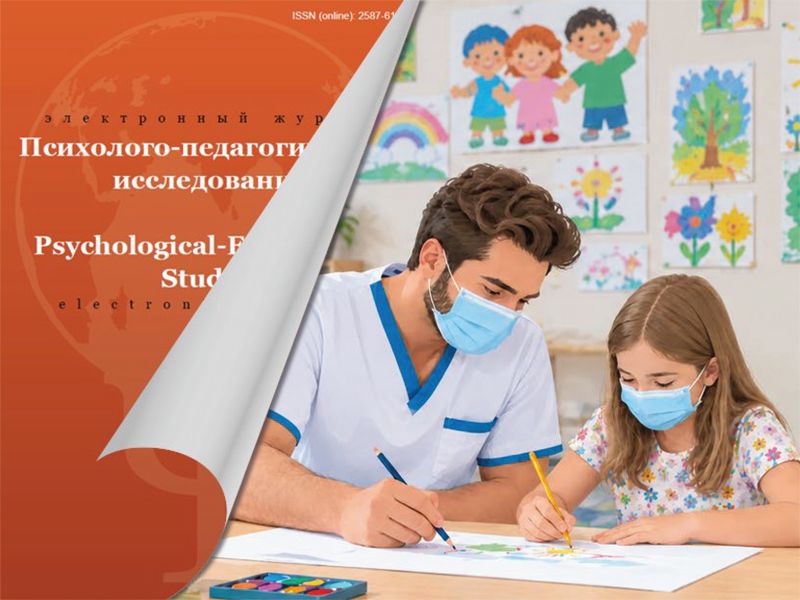
A thematic issue of the journal Psychological-Educational Studies (No. 3, 2026) has been published — “Hospital Pedagogy: The Well-Being of Children Receiving Long-Term Treatment”.
The thematic editors of the issue were Vitaly V. Rubtsov, Doctor of Sciences (Psychology), Professor, Full Member of the Russian Academy of Education, and President of Moscow State University of Psychology and Education, and Sergey V. Sharikov, Candidate of Sciences (Pedagogy) and Head of the Project Office of the “UchimZnaem” Hospital Schools Project.
The contributors to this issue focus on the education of children with chronic somatic diseases and on the creation of conditions that allow children to continue developing and learning fully during long-term treatment.
The theoretical and empirical studies examine possibilities for organizing education with due regard for a child's health condition, individual characteristics, and emotional state. Particular attention is given to the development of learning motivation, higher mental functions, and the psychological well-being of young patients through their active involvement in the educational and upbringing process.
The studies presented in this issue develop the ideas of the cultural-historical and activity-based approaches and show what role the educational environment can play in sustaining a child's development in the situation of a long-term illness.
The practice-oriented materials introduce readers to the experience of hospital educators who adapt the content, forms, and methods of instruction to the needs of children undergoing treatment. One of the key tasks of such work is to create conditions not only for the continuation of education but also for self-realization, communication, and the preservation of a child's familiar life context.
A distinct theme of this issue is interdisciplinary interaction among physicians, educators, psychologists, and social workers. The integration of medical knowledge, psychological support, and modern educational technologies makes it possible to form a comprehensive system of care for children and their family.
The issue also presents the experience of developing the Russian model of hospital schools within the flagship “UchimZnaem” Project and its dissemination at the international level. The project's practice shows how a hospital school can become for a child not merely a place to continue learning but a space for full-fledged life, development, and communication during long-term treatment.
Listen to episodes of the *PsyJournals LIVE* podcast, in which authors discuss their research:
- Sabina Igorevna Asmerzaeva on the link between emotional-personality traits and the coping strategies of primary school students with onco-hematological conditions.
- Yulia Evgenievna Kurtanova on the characteristics of school motivation among children and adolescents with cancer undergoing long-term treatment.
- Alexander Fedorovich Loskutov on how natural science teachers adapt to the professional environment of a hospital school.
- Yulia Pavlovna Zamyshlyaeva and Sergey Dmitrievich Shiryaev on the relationship between academic motivation and self-esteem in adolescents with cancer as they study natural science subjects.
- Anastasia Alekseevna Brilliantova on the characteristics of the student population undergoing long-term treatment.
- Anastasia Georgievna Putintseva on the dynamics of cognitive and sensorimotor functions in hospital school students with cancer.
- Elena Sergeevna Tusheva on modifying educational research activities while implementing new professional training models for special education teachers.
The full issue of the journal is available in open access on the psychological publications portal PsyJournals.ru.