
On artificial intelligence in the Lens of Cultural-Historical Psychology in the "Cultural-Historical Psychology" journal
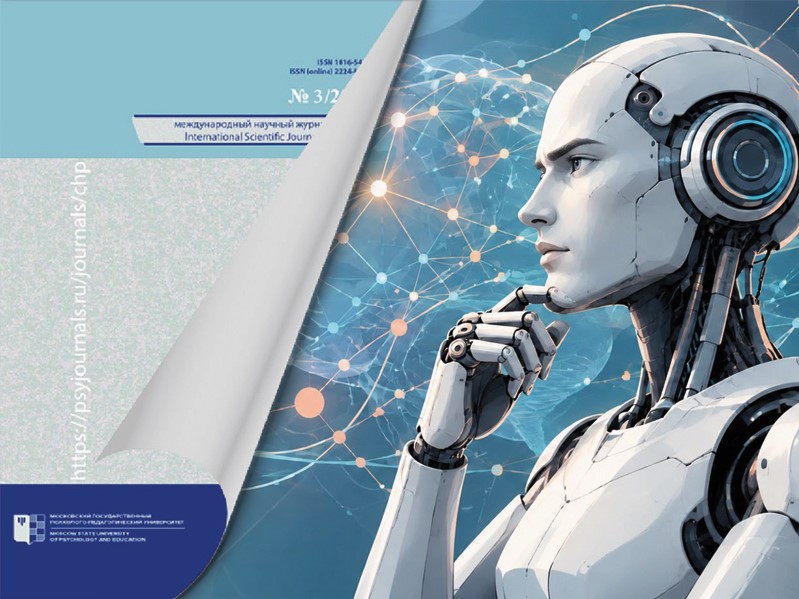
The third issue of the journal “Cultural-Historical Psychology” for 2026 has been published, prepared under the thematic guidance of V.V. Rubtsov and V.T. Kudryavtsev. The theme of the issue is “Artificial Intelligence through the Lens of Cultural-Historical Psychology”.
The central place in the issue is occupied by the conceptualization of the phenomenon of artificial intelligence through the prism of the cultural-historical approach. AI is examined as a cultural tool, and the heuristic possibilities and limitations of this metaphor are analyzed. Special attention is given to the problem of agency in the context of digital childhood — the possibilities of its initiation and suppression.
A number of publications are devoted to the transformation of communicative and cognitive processes under the conditions of new technological realities. The article examines the specific features of communicative interaction between a psychologist and a virtual client in training psychotherapeutic speech skills, as well as the role of AI assistants and recommendation systems as agents of socialization for the new generation.
In the “Educational Psychology” section, a paper is presented devoted to the relationship between verbal-logical thinking and reading skill at the stage of transition from kindergarten to school.
The empirical studies in the issue cover a wide range of topics: from the propensity to experience shame and the level of authenticity during emerging adulthood to the image of Russia in the perceptions of young Belarusians and attitudes toward integration cooperation. The problem of gamification in education is also raised, and a model of compromise between external motivation and existential well-being is proposed.
In the “Criticism and Bibliography” section, reviews of the book “Dialogues about Vygotsky” and a piece titled “A book in dialogue: L.S. Vygotsky’s ideas a century on” are presented.
The “Memorable Dates” section is dedicated to two significant anniversaries. For the 130th anniversary of Jean Piaget, the correspondence between A.R. Luria and J. Piaget from 1930–1966 is published with an afterword. The 90th anniversary of A.A. Leontiev is marked by an article on theoretical and applied psychology of communication. The issue concludes with a piece on developmental facilitation for “Homo Loquens” and an interview with T.V. Akhutina.
Listen to episodes of the *PsyJournals LIVE* podcast, in which authors discuss their research:
- Sergey Pavlovich Pudenko on agency (subjectivity) in the context of a "digital childhood": the possibilities for its initiation and suppression.
- Alexander Sergeyevich Eliseenko on the specific communicative dynamics between a psychologist and a "visual client" during training in psychotherapeutic discourse.
- Regina Vyacheslavovna Ershova on AI assistants and recommendation systems as agents of algorithmic socialization.
- Tatyana Nikolayevna Tikhomirova on verbal-logical reasoning and reading skills: a cross-longitudinal analysis of their reciprocal influence during the transition from kindergarten to school.
- Svetlana Vladimirovna Sidorenkova on the propensity to experience shame and the level of authenticity during emerging adulthood.
- Sofya Andreyevna Makarova on the dilemma of gamification in education: a compromise model balancing extrinsic motivation and existential well-being.
The full issue of the journal is available in open access on the psychological publications portal PsyJournals.ru.