
On Religious Discourse and the Phenomenon of Self-Translation in the "Language and Text" Journal
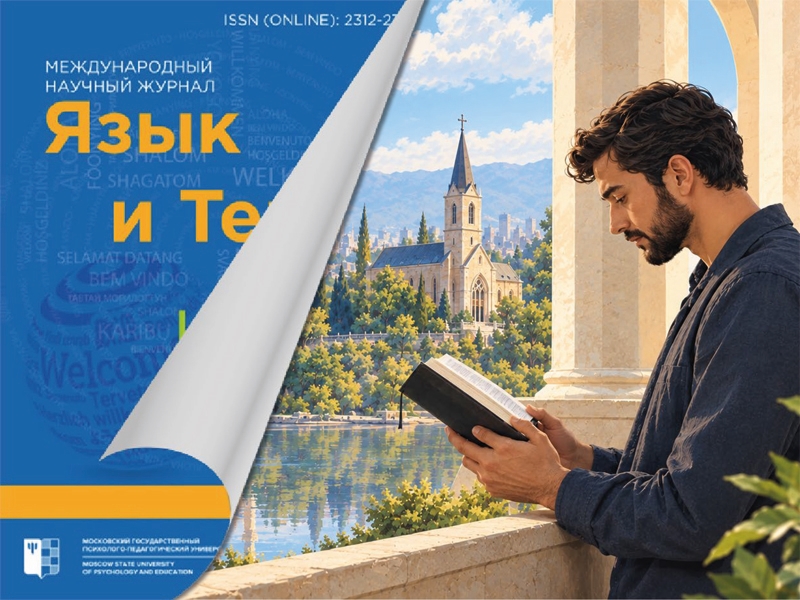
A new issue of the Language and Text journal (2026, Vol. 13, No. 3) has been published, focusing on current issues in general and comparative-historical linguistics, world literature, textual criticism, and linguodidactics. This issue brings together contemporary research that enables a deeper understanding of the patterns of language functioning across various types of discourse, the specifics of self-translation, and the mechanisms of preserving and transmitting literary and manuscript traditions.
A significant portion of the issue is dedicated to cognitive linguistics, comparative-historical linguistics, and linguodidactics. Researchers analyze the discursive variability of the concept of "sacrifice" in secular and Orthodox consciousness, the linguistic representation of the Russian village world in the prose of V.N. Krupin, and the pragmatic-stylistic functions of anglicisms in V.V. Nabokov’s self-translations. Special attention is given to the syntax of ergative languages: based on material from the Rutul language, the necessity of introducing the term "agent-subject" is substantiated. These works demonstrate how semantic and syntactic features shape a unique linguistic worldview and influence text perception.
The "World Literature. Textual Criticism" section focuses on the attribution, dating, and manuscript traditions of classical literary monuments. The articles present new arguments supporting Hegumen Moses’s authorship of The Tale of Igor's Campaign, explore the semantic role of quotations from The Ladder of Divine Ascent in the spiritual letters of St. Ambrose of Optina, and examine the literary heritage of A.S. Norov, as well as the poetics of the title and genre memory in M.Yu. Lermontov’s "Duma." Archaeographic findings hold a special place: an archival manuscript copy of the Siberian Chronicle by I.L. Cherepanov and an 1813 notebook from the collection of A. Baranovsky, which contains a possible trace of a lost Lyceum poem about a rose by A.S. Pushkin, are introduced into scientific circulation for the first time.
The issue concludes with materials on modern methods for developing communicative competence. These papers demonstrate how integrating multimodal texts (longreads, infographics, and mind maps) into the educational process helps master's and PhD students overcome challenges related to grammatical accuracy and material generalization, thereby increasing motivation and improving the quality of oral monologic speech in a foreign language.
This issue will be of interest to specialists in philology, linguistics, literary studies, and textual criticism, university faculty, and anyone studying the history of Russian literature and the patterns of language functioning within a text.
The full issue of the journal is available in open access on the PsyJournals.ru portal.